






Last week, I walked you through why w/kg isn’t the best measure for women’s racing. As promised, this week we’re taking a deeper look at how ZRL’s current category system doesn’t just create an uneven playing field—it actively disadvantages lighter women while protecting heavier riders.
And honestly? The data speaks for itself!
Here’s the issue: the ZRL Development League uses w/kg as the gatekeeper for category advancement. ZRL’s Women’s Development League CAT C, for example, caps out at 3.08 w/kg. Sounds straightforward, right? But when you layer in the physics of actual racing, something deeply unfair emerges. Lighter riders get bumped up faster, while heavier riders with lower w/kg—but higher absolute watts—stay put and rack up wins.
Let me show you exactly how.
The CAT System’s Hidden Bias
Before we dig into the numbers, let’s be clear about how ZRL categories work. Your zFTP gets converted to w/kg, and that ratio determines where you race. Simple enough on paper.
But here’s where physics has a few more cards to play: the same w/kg threshold means completely different things depending on a rider’s weight.
The same w/kg threshold means completely different things depending on a rider’s weight.
I used the same two riders from my last article — but for the sake of example, both now hovering at the CAT C limit of 3.08 w/kg and worried about getting bumped up:
| Rider | Weight | zFTP | w/kg | Absolute Power |
|---|---|---|---|---|
| Heavier Rider | 69.3 kg | 213w | 3.08 w/kg | 213w |
| Lighter Rider | 50 kg | 154w | 3.08 w/kg | 154w |
Same fitness metric. Same category. But 59 watts of difference in absolute power. That’s not subtle. That’s physics saying one rider has a massive advantage.
Now, here’s where the trap snaps shut: when these two riders race together, who’s more likely to win?
The heavier rider. Every single time, on most terrain.
And yet—because the lighter rider’s w/kg is climbing faster (she has to work harder to stay competitive)—she’s the one who gets upgraded first. She leaves the the Development League. The heavier rider? She stays, accumulates wins, and brings in lots of points for her team, possibly never hitting that 3.08 w/kg ceiling.
This is the systemic bias baked into the ZRL CAT system. And it’s worth understanding in detail.
Time to Geek Out: How Watts Win Races
I’ll walk you through today’s ZRL race using Best Bike Split. We’re going to compare two riders on the Cobbled Climbs circuit and show you exactly why absolute power matters more than the category system admits.
Our Test Riders:
| Rider | Weight | zFTP | w/kg | CAT |
|---|---|---|---|---|
| Rider A (Heavier) | 69.3 kg | 213w | 3.08 w/kg | CAT C |
| Rider B (Lighter) | 50 kg | 154w | 3.08 w/kg | CAT C |
Same w/kg. Same category. Both pushing hard at 3.07 w/kg—a high effort that’s right at the CAT C ceiling.
The Course: Cobbled Climbs—3 laps of 9.2 km each, totaling 27.6 km. Rolling terrain with 1.38% weighted grade and effective elevation of +114/-114 m per lap. It’s the kind of course where you’d think lighter riders shine. Spoiler: they don’t, when the power gap is this wide.
Head over to the Best Bike Split Cobbled Climbs analysis and follow along.
First, let’s set up Rider A. Input her weight (69.3 kg) and adjust the power slider until her w/kg reads exactly 3.07. That puts her at 210 watts—a hard, sustained effort over one lap.
Her time over one lap? Roughly 17:46.
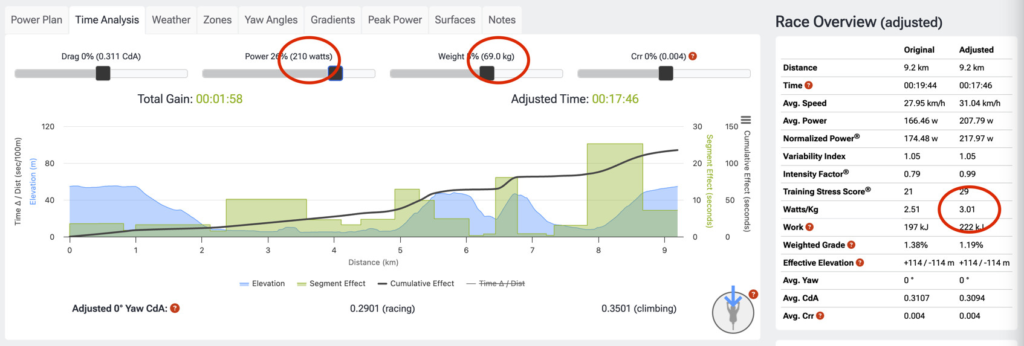
Now, here’s the critical part, without changing the power, switch the weight to Rider B (50 kg). Same 210 watts, different body.
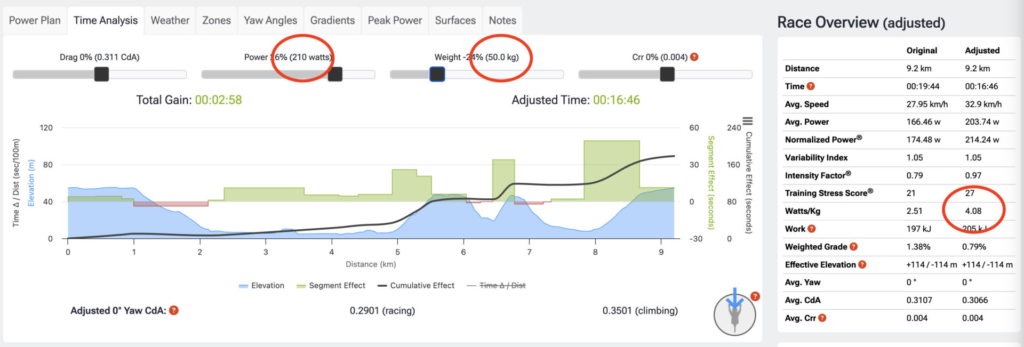
Here’s what happens: Rider B’s w/kg jumps to 4.08 w/kg—well above the CAT C ceiling. But that’s not realistic; Rider B only has 154w zFTP. So let’s adjust the power down to match her actual fitness. Note: The watt values corresponding to 3.08 w/kg for each rider are slightly lower than the exact mathematical equivalents, as Best Bike Split factors in additional variables like CdA and Crr.
Set the power to 153w for Rider B at 50 kg. Now her w/kg reads 3.08—same as Rider A.
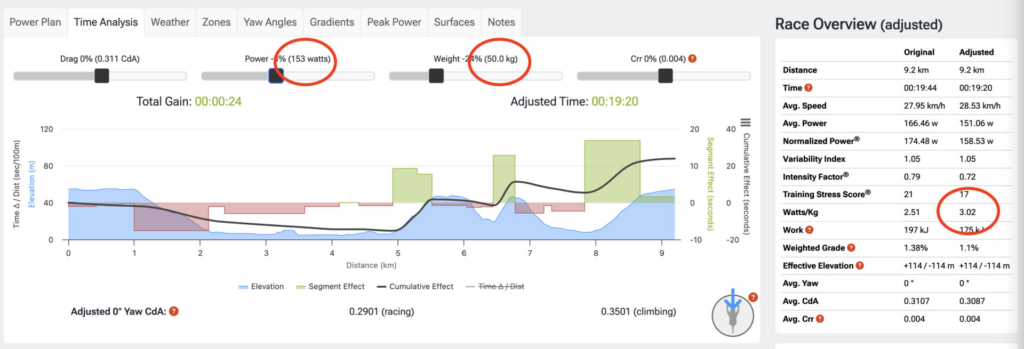
Her time over the one lap? 19:20.
94 seconds slower! Same fitness metric. Same effort level. Different outcome. And that’s just one lap!
Here’s the kicker: across the full 3-lap Cobbled Climbs race (27.6 km), Rider A finishes in roughly 59:15, while Rider B comes in at 65:30—over 6 minutes behind, despite both holding the exact same 3.07 w/kg effort.
Why? Because physics cares about raw watts. Rider A has 59 more watts, and those watts translate directly into speed. Even on a climb—where lighter riders are supposed to dominate—the power advantage is decisive.
Let that sink in. Same fitness metric. Same effort level. Completely different race outcome.
And yet, if Rider B’s power climbs to 154w (3.08 w/kg), she gets bumped from Development CAT C. Rider A can stay in CAT C at 213w (3.08 w/kg) . . . and keep winning.
This is the system working exactly as designed—and exactly wrong for lighter riders.
The Upgrade Trap: Why Lighter Riders Leave, Heavier Riders Stay
To put it plainly, the CAT system encourages a flawed set of incentives.
For a lighter rider to be competitive in her category, she often needs to push her w/kg higher than heavier riders in the same category. That’s because the heavier riders have an absolute power advantage that w/kg alone doesn’t capture. So she trains harder, her zFTP climbs, and—boom—she hits the upgrade threshold and moves up a category.
Meanwhile, the heavier rider? She’s winning races at a lower w/kg. She’s not under the same pressure to upgrade. She stays longer, accumulates more points, and earns more points for her team before finally crossing into the next category.
This creates a sorting mechanism that looks fair on paper but actually sorts riders by weight first and fitness second.
Here’s a real-world pattern I’ve observed in ZRL:
Lighter women in CAT C often find themselves pushing toward 3.2–3.3 w/kg just to stay competitive with heavier riders at 3.0–3.08 w/kg. The moment they hit 3.08, they’re out. Kicked from the Development League, and moved to a field that is even tougher—and the power gaps even wider.
Heavier riders? They cruise at 2.9–3.0 w/kg, win races, and stay in Development CAT C longer. By the time they upgrade, they’ve racked up multiple podiums and strong ranking points for their team.
The system isn’t measuring fitness fairly. It’s measuring which body type the system was designed for.
The Real Cost: Lighter Riders Lose Team Ranking Points
In ZRL, points are everything. They determine your team’s standing, visibility, and shot at advancement and recognition. And the CAT system—by keeping heavier riders in lower categories longer—gives heavier teams more opportunities to earn those points.
For this example, the data is based on the team currently sitting in first place overall in the Development CAT C Division, where Team OWL is competing. Let’s take a look at the results from the most recent points race: the 2019 UCI Worlds Harrogate Circuit.
These are the riders weights in kg:
| Team | 1 | 2 | 3 | 4 | 5 | Tot | AVG |
|---|---|---|---|---|---|---|---|
| Division Top Team | 75.3 | 64.9 | 65.6 | 57.0 | 53.1 | 315.9 | 63.18 |
| Team OWL | 60.0 | 53.0 | 50.0 | 53.5 | 61.7 | 278.2 | 55.64 |
The team average weight for the top team is 63.18 kg.
Now look at their race results: 2nd, 14th, 19th, 23rd, and 52nd place.
See the pattern? The heavier riders finished higher. Their 75.3 kg rider took 2nd. Their 64.9 kg and 65.6 kg riders placed 14th and 19th. The lighter ones trailed further back. This isn’t coincidence—it’s physics. More weight means more absolute watts, and watts win races.
With the exception of the last rider—who finished 52nd on ZwiftPower—all participants are classified as CAT C Women and CAT C Combined on ZwiftPower. The final rider falls under the C/D category and weighs 53.1 kg. Under Zwift’s category system, CAT C corresponds to an FTP range of roughly 2.5–3.2 w/kg and a minimum of 150 W in absolute power. This means that for their lightest rider at 53.1 kg, qualifying requires around 2.82 w/kg, while their heaviest rider only needs 1.99 w/kg to move into CAT C Combined.
Now let’s look at five riders from Team OWL currently in 9th place overall.
For Team OWL the average weight is 55.64 kg.
Our race results in the same Harrogate Circuit race: 10th, 31st, 43rd, 45th, and 46th place.
Age aside (we’re all 65+), our two heaviest riders—at 60.0 kg and 61.7 kg—along with our mighty pocket rocket at 53 kg, all sit in CAT C/C. The rest of us fall into CAT D/D.
Here’s the crushing part: our pocket rocket who came in 31st—a solid, competitive finish—weighs 53.0 kg. She’s already nervously close to the CAT C upgrade threshold.
For her to stay in Development CAT C, she can’t race faster than 159 watts (3.0 w/kg). One more good race, one more push, and she’s bumped from the Development League.
Meanwhile, the top team’s 75.3 kg rider who beat our pocket rocket by 29 positions? She can speed by at 226 watts (3.0 w/kg) before facing an upgrade. That’s 67 more watts of headroom.
Think about that. Our rider has to hold back. Their rider can keep pushing.
This is the CAT system in action. It doesn’t just disadvantage lighter riders in individual races. It systematically keeps heavier teams in lower categories longer, giving them more races to accumulate points, more podiums to rack up, more opportunities to build an insurmountable ranking lead.
Lighter teams? We potentially lose our strongest riders to upgrades. We’re fighting with one hand tied behind our backs.
And the system calls it fair.
Frustrated? You’re not alone!
I’ve watched Team OWL riders pour everything into races. For most of us featherweights, matching the power output of heavier riders just isn’t possible. Instead of feeling proud of our effort, the current system leaves us thinking we’re not good enough—not strong enough. But that’s not on us. That’s on a broken system.
And our riders who finish competitively? As featherweights, they immediately face the threat of upgrade.
But the truth is simpler and more infuriating: lighter women are being pushed out of a category where they could have competed fairly, by a system that doesn’t account for the physics of their body. And in doing so, the system disadvantages entire teams.
This isn’t about individual fitness. This is about structural bias that compounds across every race, every season, every ranking.
Knowledge is Power
I’m not writing this to bash Zwift, ZRL or WTRL. I’m writing this because I love Zwift racing, and I believe it can be better. I believe lighter women deserve a fair shot at competitive racing without being sorted out of their category by a metric that doesn’t account for their physics.
This is where the myths start to crumble. The myth that the same category threshold means the same thing for every body. The myth that lighter riders just need to “get stronger” to stay competitive.
The data tells a different story. And it’s time the racing community—and the platforms we race on—listened.
Our strength isn’t always measured in watts per kilo; sometimes, it’s in the wisdom to understand the game and demand a fair one.
Stay tuned for Part 3, where I’ll explore how this imbalance becomes even more pronounced in combined men’s and women’s racing—where women are almost always at a weight disadvantage.
Want to dig deeper into the physics yourself? Head to Best Bike Split and run these scenarios. Compare riders at the same w/kg but different weights. See the power gaps for yourself. The data doesn’t lie—and once you see it, you can’t unsee it.
OWL.BiKe fans Save 25% off any of Best Bike Split’s premium subscriptions—a great way to unlock advanced features for smarter training and race strategy. Use the chatbot, or add a comment below to request a promo code.

Follow me on substack »
Zwift for the Rest of Us

Elizabeth Evans
Hmmm…..I just lost around 10 – 15 lbs. Does this mean I should eat more?? Lol :)
Chris Dahlberg
Hard to completely wrap my head around all of the details. But I did have a question myself a few months ago regarding my own weight. The question I had was if I lost 30 pounds, which I could as long as I didn’t lose muscle, where would my power scores be then? I asked AI and it came back and said that my FTP would not change if I lost 30 pounds. I still don’t understand that one. But I think you’re doing great work and I hope that someone at Zwift will recognize this and work on changing it. I know my sister has struggle with this because she didn’t want to get bumped up to a tougher league. Rightfully so, why would you want to participate in a league where you only faced the opportunity of defeat?
Thank you for sharing!
elaine
Hey Chris!
FTP isn’t affected by weight, so we need to look at this differently. What really matters is your watts per kilogram (w/kg), which does account for weight. Here’s an example.
– At 180 lb, with an FTP if 150 W you’re about 1.83 W/kg.
– At 150 lb (after losing 30 lb), 150 W becomes 2.20 W/kg.
W/kg is a great indicator of fitness level. In most cases, it’s easier to lose 30 pounds than to raise your fitness from 1.83 W/kg to 2.20 W/kg. Can it be done? Absolutely—but it takes structured training/coaching while managing your weight.
Sasha
I’d love to be 50kgs but at nearly 6ft I’d be in hospital! You’ve not mentioned heights or taken into account individuals physiology! I also feel aggrieved that you have called out an individual team and quoted a riders numbers, have you thought how that might make them feel! I know I’d be deeply unhappy…
elaine
That’s right! This article focuses on physics, not physiology. I’ll cover physiology—and how it influences racing—in a future piece .
All of the data I use in my articles is publicly available including team names and ranking. I also never identify individual riders by name unless they’re on Team OWL. Nothing is written to be hurtful; most readers recognize that and value learning from real-world data.